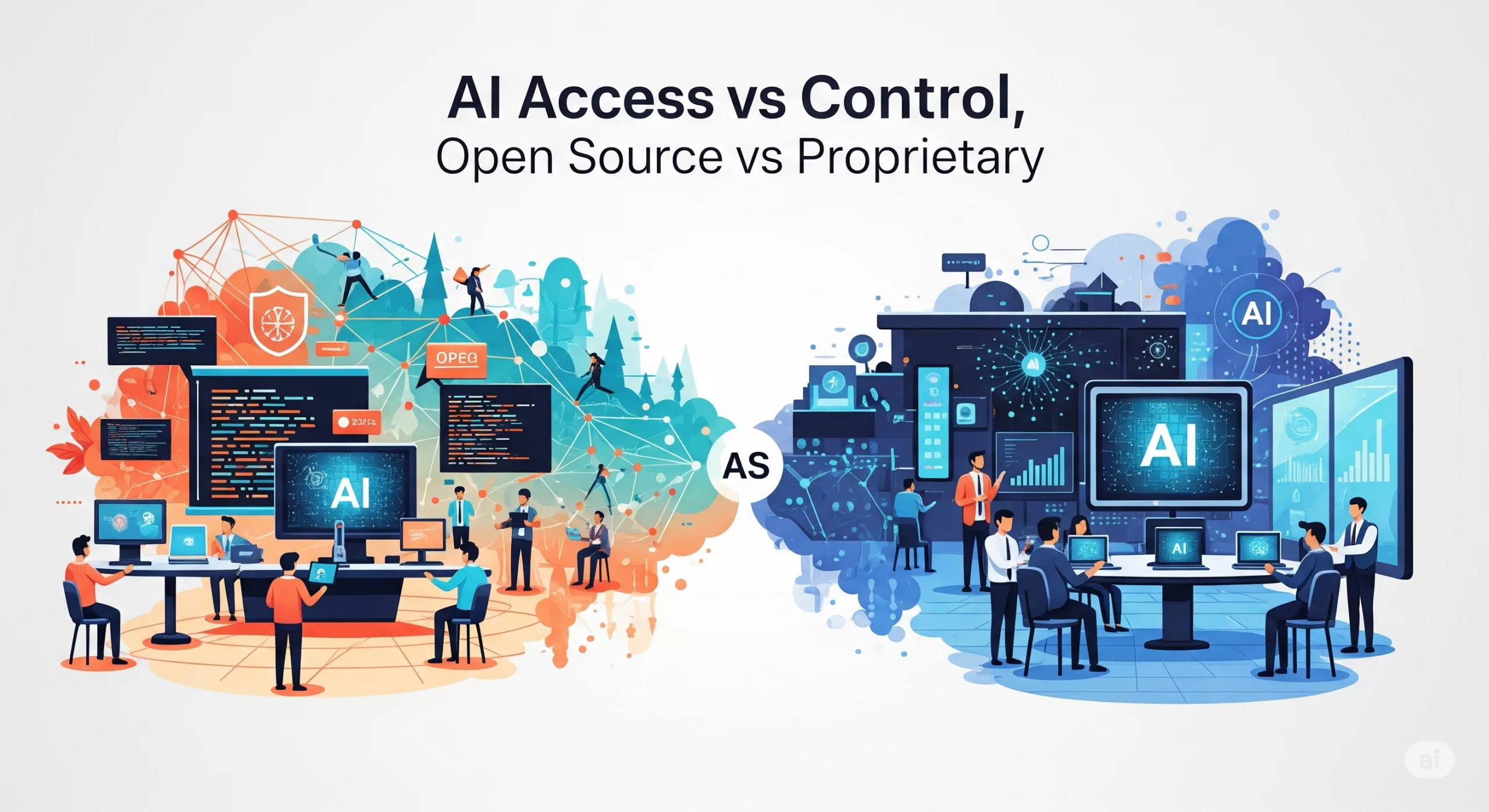
In recent years, open-source artificial intelligence has ignited lively discussion among tech experts, lawmakers, and curious minds. Open-source AI's appeal lies in its openness and collaborative potential, set against real concerns about misuse. The pressing question: can we balance transparency with security? This inquiry is both timely and practically urgent.
This post unpacks the key dimensions of that debate: what open-source AI truly entails and its benefits, what risks these technologies introduce, the arguments on both sides of access and control, and how the industry can foster innovation while protecting against misuse.
Key takeaways
- Open-source AI means public code and weights: Frameworks like TensorFlow and PyTorch allow anyone to inspect, modify, and build on AI systems, enabling rapid collaborative advancement without proprietary cost barriers.
- Transparency cuts both ways: Openness lets security researchers audit for flaws and bias, but also exposes models to misuse for disinformation and cyber-attacks once weights are public.
- Economic barriers fall with open access: The World Economic Forum finds open-source AI lowers entry barriers for startups, enabling competitive innovation from unexpected sources globally.
- Closed models offer revocable access: Proprietary API-gated AI allows labs to patch, restrict, or revoke access in ways that distributed open-source releases cannot match after the fact.
- Tiered release is the emerging middle path: Staged disclosure starting with safety researchers, then broader academic access, then general availability, attempts to capture both openness and control.
What Is Open-Source AI?
Open-source AI refers to projects where the underlying code, and in some cases model weights or training data, is made publicly available for inspection, modification, and redistribution. This model opens doors for anyone to contribute to development, making rapid iteration possible at a scale no single organization could sustain. Frameworks like TensorFlow and PyTorch embody this approach, powering everything from student projects to large-scale production deployments at global companies.
The defining characteristic is community accountability: bugs get found and fixed by thousands of contributors, safety flaws get surfaced by independent researchers who have no commercial incentive to suppress findings, and improvements flow freely between organizations. As one analyst noted, "Open-source platforms democratize technology, allowing smaller enterprises to innovate without the exorbitant cost of proprietary software." By fostering community contributions, open-source projects gain varied viewpoints and real-world stress testing, producing richer and more robust evolution than closed development alone can achieve.
What Are the Benefits of Open-Source AI Models?
Open-source AI encourages transparency and fuels innovation at a pace proprietary development rarely matches. By permitting anyone to scrutinize and refine AI algorithms, the community cultivates a culture of continuous improvement. Companies save engineering resources by building on already-developed foundations rather than reconstructing common capabilities from scratch, redirecting budget toward genuine product differentiation.
The World Economic Forum has observed that open-source AI spurs economic development by lowering entry barriers for technology startups. Providing equal access to foundational tools creates competitive conditions where breakthrough ideas can emerge from a research lab in Lagos as readily as one in San Francisco. Independent researchers can also audit open models for embedded bias and safety failures, performing a checks-and-balances function that is structurally unavailable when the system is a black box.
What Are the Risks of Open-Source AI?
Open-source AI carries real and documented risks once models are released publicly. Critics highlight cases where powerful models are adapted for purposes the original developers would prohibit. Weaponized language models could enable disinformation campaigns at scale or assist in targeted cyber-attacks, and the misuse is harder to remedy when there is no central authority that can revoke access or push a patch to all users simultaneously.
According to a Cybersecurity Journal report, "Open-source code's very nature makes it susceptible to manipulation, potentially allowing malicious actors to use AI for harmful activities." Unlike proprietary systems, open-source model weights cannot be silently updated or access-revoked after public release. Once weights are distributed, they exist on thousands of servers indefinitely. This creates asymmetric risk: the innovation benefits of openness accumulate broadly and gradually, while the harms concentrate in specific high-impact applications that may materialize suddenly.
How Do We Balance Open-Source AI Access with Control?
The essential question is whether powerful AI models should be freely accessible or kept tightly controlled. Control advocates argue that strong restrictions are necessary for the highest-capability systems, particularly those that could assist in generating novel bioweapons instructions or enable sophisticated election interference. Limiting access to frontier models may deter actors who lack the resources to train their own systems from scratch.
| Dimension | Open-source AI | Closed-source AI |
|---|---|---|
| Transparency | Full code and weight inspection | Black-box outputs only |
| Innovation speed | High; community contributions accelerate iteration | Constrained to internal team capacity |
| Misuse risk | Higher; weights cannot be revoked post-release | Lower; API access is gateable and revocable |
| Cost to access | Low to zero for researchers | API fees or licensing costs |
| Safety auditing | Community-led, decentralized, independent | Internal, controlled by the releasing organization |
| Accountability | Distributed across the community | Concentrated at the company level |
Open access supporters argue that locking AI away stifles creativity and ultimately slows beneficial societal progress. As technologist Maya Patel noted, "Innovation thrives in environments of openness and trust." The middle path emerging in practice is tiered release: open research weights for academic use, restricted weights for higher-risk applications, and full closure for the most capable frontier systems. Neither extreme serves all use cases equally well.
How Can the AI Industry Innovate Responsibly?
Responsible innovation requires treating openness and control not as binary opposites but as design variables to be calibrated per release. Establishing ethical frameworks surrounding open-source AI is crucial for preserving its advantages while limiting its highest-risk applications. This means adopting usage licenses that permit research and commercial use while prohibiting documented high-risk cases, building safety evaluations into release workflows, and participating in cross-industry standards bodies that provide independent oversight.
Organizations like OpenAI have started publishing ethical guidelines and promoting community-led initiatives that encourage safer AI practices globally. The most promising pattern involves staged disclosure: red-teaming by independent safety researchers before any release, tiered access starting with vetted academic and nonprofit users, public model cards documenting known failure modes and prohibited uses, and ongoing monitoring of post-release deployment. Responsible innovation is not about choosing access or control but about sequencing them deliberately, with safety evaluation preceding each new stage of availability.
Conclusion
Open-source AI holds the promise of both extraordinary innovation and genuine danger. The central challenge is fostering a balance that encourages creativity and democratizes capability while mitigating the risks that come with distributing powerful systems widely. Advocating for both access and control, sequenced thoughtfully and calibrated to model capability, could lead to healthier advancements and broader participation within the AI landscape.
As technologists and stakeholders, accepting the responsibility that accompanies these tools is not optional. Open-source AI's future hinges on how the community navigates the complex terrain between innovation and ethical obligation. The debate is not access versus control: it is about designing access frameworks that make meaningful control possible at each stage of a model's lifecycle.
Frequently asked questions
What is the main difference between open-source and closed-source AI models?
Open-source AI makes the underlying code, and sometimes model weights, publicly available for inspection and modification. Closed-source AI exposes only outputs via an API or interface. Key practical differences include: transparency (open-source allows independent auditing for bias and safety), innovation speed (community contributions iterate faster), and misuse risk (open weights cannot be revoked once released, unlike API access which can be gated or terminated at any time).
Can open-source AI models be made safe enough for public release?
Safety in open-source AI is achievable but requires deliberate design choices. Staged release, starting with safety researchers before general availability, allows issues to surface in controlled settings. Usage licenses can prohibit specific high-risk applications. Safety filters and alignment fine-tuning can be included in the public release. No single mechanism is sufficient alone, but layered approaches have worked for models like Llama and Mistral without enabling widespread documented abuse at the time of their release.
Why do some AI companies choose not to open-source their models?
Closed-source decisions reflect a combination of commercial, safety, and competitive motivations. Commercially, API access creates a recurring revenue stream that releasing weights would eliminate. From a safety standpoint, closed access allows rapid patching without requiring distributed users to update. Competitively, keeping weights proprietary prevents rivals from fine-tuning the organization's research investment. Frontier labs have cited both commercial sustainability and catastrophic-risk prevention as drivers for closed releases.
What is a responsible disclosure framework for AI models?
A responsible disclosure framework for AI models typically involves pre-release red-teaming by independent safety researchers, a tiered access rollout starting with vetted academic and nonprofit users, public model cards documenting known failure modes and prohibited use cases, and a post-release mechanism for reporting misuse. This mirrors vulnerability disclosure practices in cybersecurity and aims to give the safety community time to characterize risks before a model reaches the broadest possible audience.
Further Reading
- Open AI Charter, OpenAI principles on broadly distributed AI benefits
- Hugging Face Model Hub, Open platform for sharing and democratizing AI models
- EleutherAI, Nonprofit AI research collective promoting open-source models
- Partnership on AI, Coalition addressing AI access and fairness
- Mozilla Foundation AI, Open-source AI initiatives and responsible development
- AI Index Report, Stanford comprehensive annual AI progress tracking