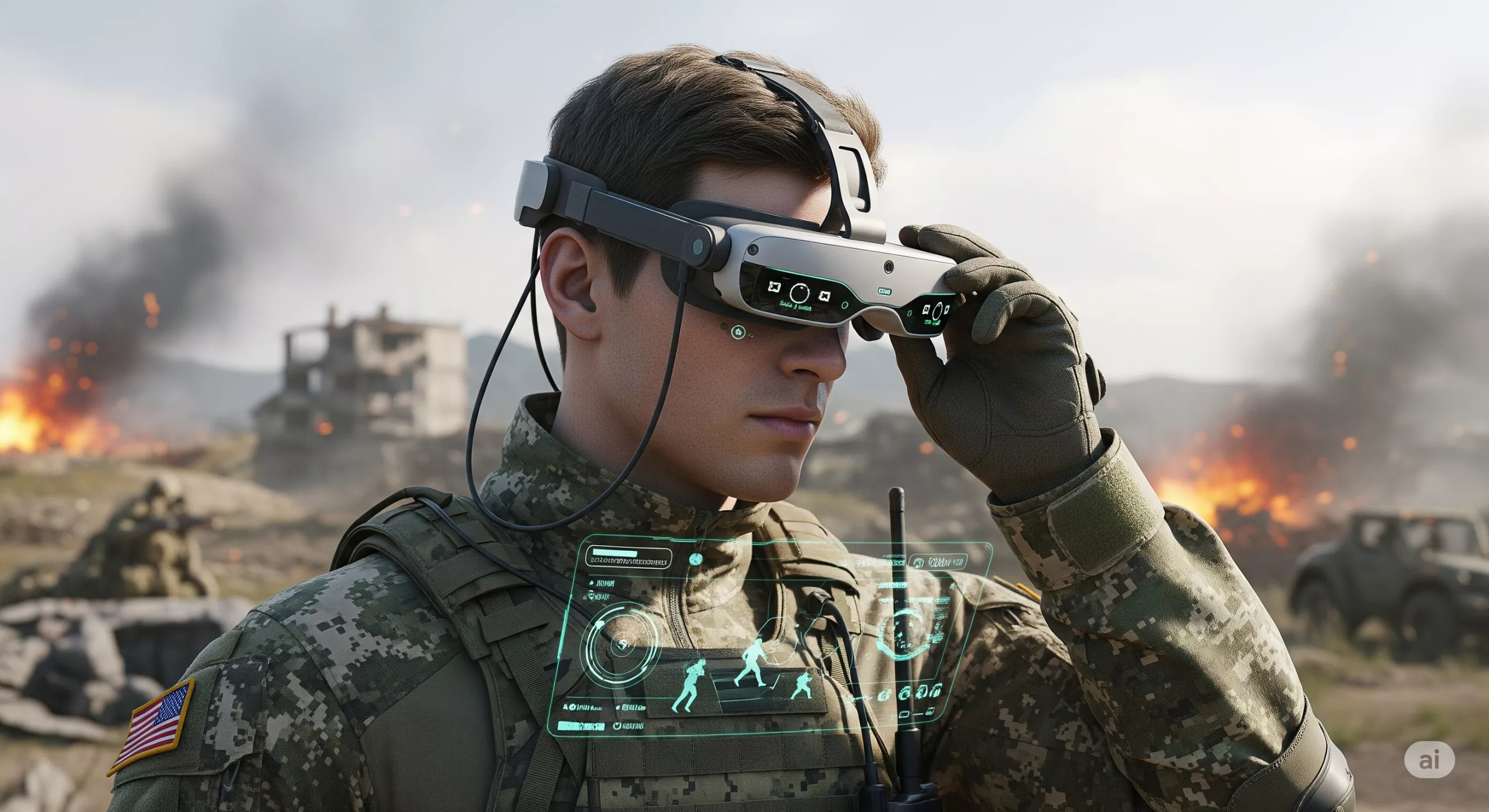
Military VR applications revolutionize modern warfare through advanced virtual and Extended Reality technologies. Defense forces worldwide use immersive technologies for combat training, battlefield awareness, equipment maintenance, and strategic planning, creating amazing operational advantages.
As conflicts become increasingly complex, military modernization programs demand innovative solutions that enhance soldier effectiveness while reducing training costs and operational risks.
Key takeaways
- VR improves training retention: U.S. Army Research Laboratory data shows VR training boosts skill retention and combat readiness by up to 47% while reducing required training hours.
- IVAS situational awareness: The Integrated Visual Augmentation System improves soldier battlefield awareness by 73%, according to Army Futures Command testing.
- AR cuts maintenance time: AR-guided repair procedures reduce equipment repair time by 60% and decrease maintenance errors across complex military systems.
- $17.5 billion market by 2030: The global military simulation market is projected to reach $17.5 billion by 2030, driven primarily by VR application growth.
- 78% military adoption: 78% of major military forces now deploy VR training systems, with a 156% increase in military VR investment over the past three years.
- AI-adaptive training: DARPA is developing AI-powered VR that adjusts training difficulty in real time based on individual soldier performance data.
How Does VR Improve Military Combat Training?
Virtual Reality military training offers cost-effective, repeatable experiences replicating real-world combat scenarios. Advanced systems like Synthetic Theater of War (STOW) enable personnel to train without leaving facilities. Military VR applications extend beyond combat training to include combat medic training and emergency medical procedures, where VR simulation provides risk-free practice for life-saving techniques in battlefield conditions.
Key VR training advantages:
- Unlimited scenario repetition for skill mastery
- Safe training environment eliminating physical risks
- Cost reduction vs. live-fire exercises
- Standardized training across military units
- Real-time performance assessment
- Multi-unit coordination exercises
- Combined arms and inter-service coordination
Research from the U.S. Army Research Laboratory (2025) shows VR training improves skill retention and combat readiness by up to 47% while reducing required training hours.
How Does XR Enhance Soldier Battlefield Awareness?
The Integrated Visual Augmentation System (IVAS) provides soldiers with real-time battlefield information through advanced AR goggles, offering enemy identification, terrain analysis, friendly force awareness, and night vision integration.
Army Futures Command (2025) testing shows IVAS enhances situational awareness by 73%, directly improving soldier survival rates and mission success. Military XR systems integrate live intelligence feeds, satellite imagery, and sensor data for complete battlefield visualization.
How Is VR Used in Military Maintenance and Logistics?
AR-guided maintenance operations provide technicians with step-by-step instructions, technical manuals, and diagnostic information overlaid directly onto equipment.
Maintenance VR benefits:
- 60% reduction in repair time through guided procedures
- Decreased maintenance errors and equipment downtime
- Remote expert assistance features
- complete maintenance documentation
- Training acceleration for complex systems
How Do Military Commanders Use VR for Strategic Planning?
Military commanders use VR for complete mission planning, terrain analysis, and tactical scenario development. The Tactical Ground Reporting system lets you real-time visualization of troop movements, enemy positions, and environmental factors.
Defense Intelligence Agency (2025) personnel use VR to analyze complex intelligence data, visualize threat patterns, and identify strategic opportunities through immersive data representation including multi-source intelligence fusion, pattern recognition, and geospatial intelligence visualization.
How Does VR Accelerate Military Equipment Development?
Military equipment development leverages VR for virtual prototyping, reducing physical prototype costs while accelerating development. Defense Innovation Board (2025) reports VR integration increases innovation speed by 45%.
VR lets you international military forces to participate in joint exercises within shared virtual environments. NATO forces (2025) increasingly use VR platforms for cost-effective multinational exercises, enhancing allied force coordination and standardized operational procedures.
| Application Area | Primary Technology | Key Benefit | Measured Impact |
|---|---|---|---|
| Combat training | VR headsets + motion tracking | Safe, repeatable scenario training | 47% skill retention improvement |
| Battlefield awareness | AR goggles (IVAS) | Real-time situational data overlay | 73% awareness improvement |
| Equipment maintenance | AR guided procedures | Step-by-step repair instructions | 60% reduction in repair time |
| Strategic planning | VR command environments | 3D terrain and force visualization | Faster decision cycles |
| Equipment development | VR prototyping | Virtual prototype testing before build | 45% increase in innovation speed |
| Joint exercises | Multi-user VR platforms | Multinational training without travel | Significant logistics cost reduction |
Emerging Technologies and Security
Artificial intelligence integration with military VR systems creates adaptive training environments responding to individual soldier performance. DARPA research (2025) explores AI-powered VR for personalized training difficulty adjustment, real-time performance analysis, predictive scenario generation, and adaptive mission planning.
Military VR systems require solid cybersecurity measures protecting classified information. U.S. Cyber Command (2025) develops specialized security protocols including encrypted communication channels, secure data storage, identity verification, and regular security audits.
While initial VR system investments range from $100,000-$2 million per platform, military Companies report significant long-term savings through reduced training ammunition costs, decreased equipment wear, lower injury rates, better mission success, and improved soldier retention.
Global Market and Adoption
The global military simulation market (2025) is projected to reach $17.5 billion by 2030, with VR applications driving significant growth. 78% of major military forces now use VR training systems, with a 156% increase in military VR investments over the past three years and a 67% improvement in training effectiveness compared to conventional methods.
Defense budgets reflect this shift: the U.S. Department of Defense allocated over $1.2 billion toward simulation and training technologies in fiscal year 2025, up from $780 million in 2022. The United Kingdom, Australia, Israel, and South Korea are each running major XR procurement programs. Among private sector suppliers, companies like CAE, L3Harris, Bohemia Interactive Simulations, and Elbit Systems have expanded their XR divisions significantly to meet increasing demand. Analysts expect the compound annual growth rate for military VR to hold above 18% through 2030, with training simulation and maintenance support as the two fastest-growing segments.
Conclusion: The Future of Military Technology
Military VR applications represent a fundamental transformation in defense features, offering amazing advantages in training, operations, and strategic planning. The evidence shows VR’s critical value: better training outcomes, improved battlefield awareness, reduced operational costs, and increased mission success rates. Beyond operational training, VR therapy for PTSD treatment demonstrates VR’s critical role in supporting veteran mental health and recovery from combat trauma.
Key implementation priorities:
- Invest in complete VR training programs across all military branches
- Develop solid cybersecurity protocols for military VR systems
- Foster international collaboration through shared VR platforms
- Integrate AI and emerging technologies with existing VR features
- Focus on measurable outcomes and continuous system improvement
Virtual reality is defining the future of modern warfare and defense readiness.
Frequently asked questions
What is the primary use of VR in military training?
VR's primary military training application is combat simulation. Systems like the U.S. Army's Synthetic Theater of War (STOW) replicate real battlefield scenarios without physical risk, allowing soldiers to repeat exercises until mastery is achieved. Training programs also cover combat medic procedures, multi-unit coordination, and inter-service operations. Army Research Laboratory data shows VR training improves skill retention by up to 47% compared to conventional methods.
How does the IVAS augmented reality system work in the field?
The Integrated Visual Augmentation System (IVAS) overlays real-time tactical data onto a soldier's field of view through AR goggles. The system provides enemy identification, friendly force locations, terrain analysis, night vision integration, and live intelligence feeds from satellite and sensor networks. Army Futures Command testing in 2025 found IVAS improves situational awareness by 73%, directly contributing to improved mission success rates and soldier survivability.
What does military VR cost compared to live-fire training?
Initial VR platform investments range from $100,000 to $2 million per system. This is higher than a single exercise session, but over a 5-year operational period military organizations consistently report net savings through reduced ammunition costs, lower equipment maintenance, fewer training injuries, and better retention of trained personnel. The Defense Innovation Board (2025) projects VR delivers a positive return on investment after 18 to 24 months of active deployment.
How is AI being integrated with military VR systems?
DARPA research programs are developing AI layers that adapt VR training scenarios in real time based on individual soldier performance. When a trainee demonstrates mastery of a task, the AI increases difficulty or introduces unexpected variables. When a soldier struggles, it simplifies the exercise into component steps. This adaptive approach is projected to further reduce time-to-competency while producing higher retention outcomes than fixed-curriculum VR programs or live exercises.
Are military VR systems protected against cyber threats?
Military VR systems operate under specialized cybersecurity protocols developed by U.S. Cyber Command. These include end-to-end encrypted communication channels, classified data storage with zero-trust access controls, biometric identity verification, and mandatory security audits on every update cycle. Because virtual training environments simulate classified scenarios and tactics, data security is treated as a mission-critical requirement equal to the physical systems being simulated.
Defense Resources:
- U.S. Department of Defense
- Army Futures Command
- Defense Innovation Unit
- NATO Innovation Hub
Further Reading
- DARPA Perceptually-enabled Task Guidance, Defense Advanced Research Projects Agency synthetic training initiatives
- US Army STE Program, Synthetic Training Environment transforming Army training
- Bohemia Interactive Simulations, Leading provider of military VR simulation software
- RAND: VR Military Training, Analysis of virtual reality applications in military training
- SimX Medical Simulation, VR platform for military medical training and mass casualty scenarios
- Office of Naval Research, Office of Naval Research on VR training effectiveness